FluxBench may earn a referral commission when you purchase through links on this page, at no additional cost to you. How FluxBench earns referral fees
A hot air rework station is a primary tool for assembling, desoldering, and reworking surface-mount devices (SMD) and ball grid array (BGA) components. Unlike a contact soldering iron, which transfers heat through direct physical touch, a hot air station directs heated air across solder joints to reflow multiple pins simultaneously without mechanical pressure.
When browsing online marketplaces, buyers encounter three distinct tool configurations alongside standalone replacement accessories. Because listings often feature sparse technical documentation, understanding the physical format and verifying electrical compatibility before purchasing is essential.
Standard United States wall outlets supply nominal 120V power. Marketplace listings frequently advertise 220V equipment. A listing that states "220V" is not electrically compatible with standard US 120V household receptacles. The fact that an international seller offers shipping to a US address does not mean the tool has been built for 120V operation. Do not rely on unverified adapters; buyers must verify that a listing explicitly supplies a native 110V/120V variant suitable for their local electrical supply.
Tool Formats Found in Listings
Seller listings for hot air rework tools generally divide into three equipment styles, each addressing different bench space constraints and workflow setups.
1. All-in-One Handheld Format
The integrated wand design houses the heating elements, air delivery, and user controls entirely within an elongated handheld body. Rather than tethering the wand to an external desktop console, controls and status readouts are placed directly on the handle shell.

The JCD 8208 listing represents this compact format, advertising a 750W rating and an integrated LCD digital display. This design suits hobbyists or mobile repairers with limited bench space who need an all-in-one heating tool. However, the listing title does not state its operating voltage, and physical attributes such as cord flexibility, grip weight, and airflow mechanics are not detailed by the seller. Buyers must confirm operating voltage directly with the seller before purchasing.
2. Dedicated Benchtop Station
The standalone benchtop station uses a separate desktop base unit coupled to a tethered hot air wand. The base sits on the workbench, housing power switches and adjustment controls, while a flexible cord connects to the wand.
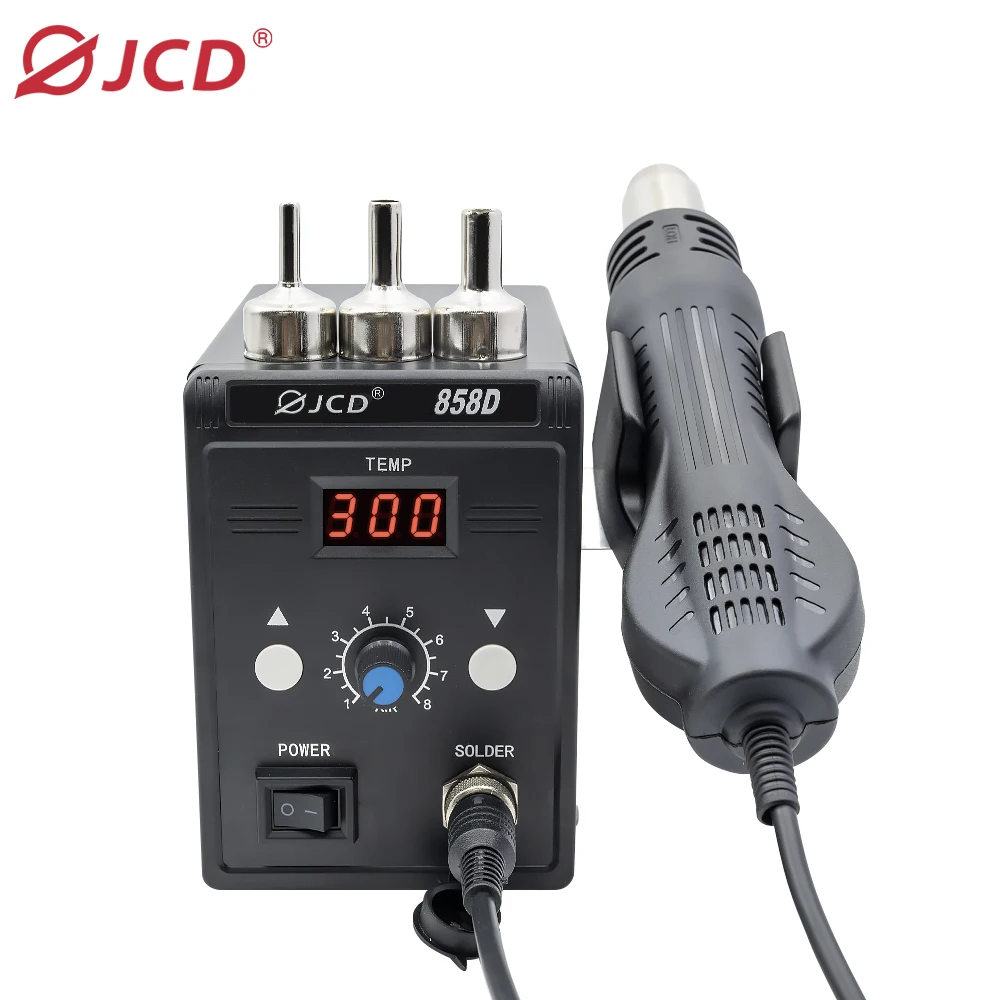
The 858D format is a longstanding baseline in rework equipment. The JCD 858D listing advertises a 700W rating and lists "220V / 110V" in its title. This indicates that multiple regional variants may exist under the same product listing. Buyers selecting this model must verify that they have chosen the specific 110V option in the purchasing menu rather than a 220V variant, ensuring it operates safely on standard domestic circuits.
3. 2-in-1 Combination Station
Combination stations merge a hot air rework system and a contact soldering iron onto a single central console. This approach reduces the need for two separate wall cords and two individual benchtop enclosures.
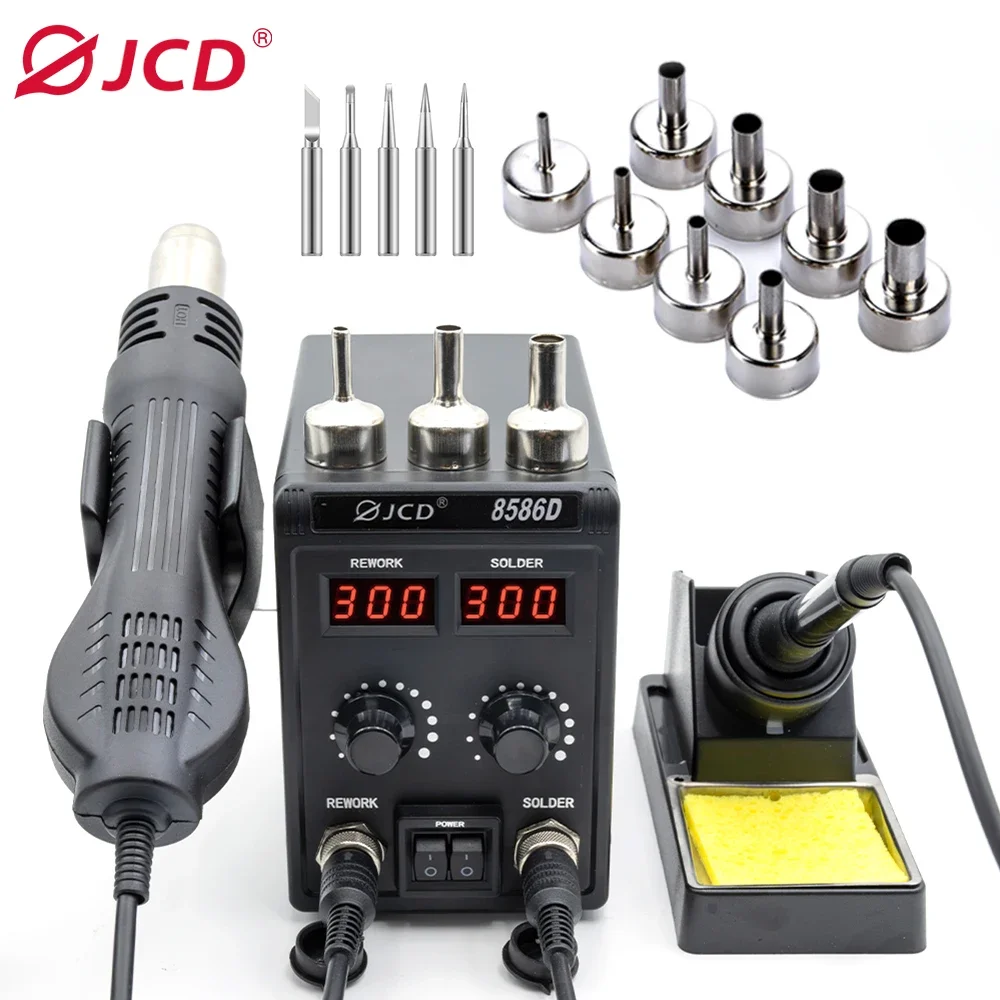
The JCD 8586D listing advertises dual digital displays (one for each tool interface) and a stated 10-minute sleep mode. However, this specific listing states "220V" in its title. For a US workbench operating on standard 120V mains, this listed unit is not natively compatible. Buyers should treat any listing marked strictly for 220V as incompatible with standard domestic wall receptacles unless an explicit 110V/120V option is confirmed by the seller.
Accessory Fitment: Nozzles
Hot air wands require focused metal nozzles to channel airflow across targeted components while shielding adjacent heat-sensitive parts. Nozzles are frequently sold individually or in aftermarket packs.
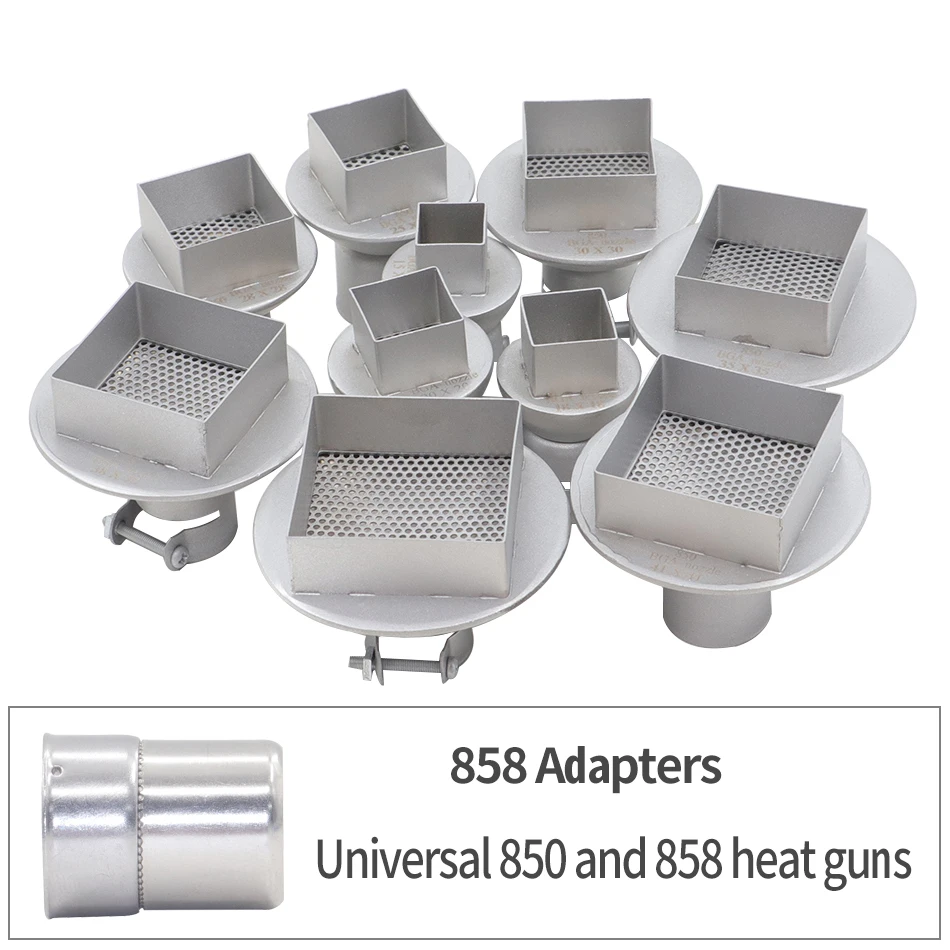
The item above is an individual replacement nozzle, not a rework station. The seller claims broad compatibility across 850 and 858 station styles (referencing brands and models such as YIHUA 853AAA, SAIKE 909D, 858D, and 8586). While many budget wands use similar collar designs, mechanical tolerances and locking styles can vary across production runs. Buyers should check the mounting diameter and retention mechanism of their existing wand collar before ordering replacement nozzles.
Buyer Verification Checklist
Because seller titles provide only top-level claims, review the following questions before completing an order:
- Voltage selection: Does the order dropdown explicitly confirm a 110V/120V model with a North American plug, or is the listing defaulted to a 220V European/Asian standard?
- Included components: Does the purchase price include the basic accessories needed to operate, such as a wand cradle, power cord, and standard nozzle sizes, or does the listing deliver only a bare tool?
- Operating controls: Does the station provide separate adjustments for both temperature and air volume, and does the display show set temperatures or active readouts?
- Fitment verification: If purchasing replacement nozzles or irons, do the collar dimensions and pin connections match your specific station's hardware?